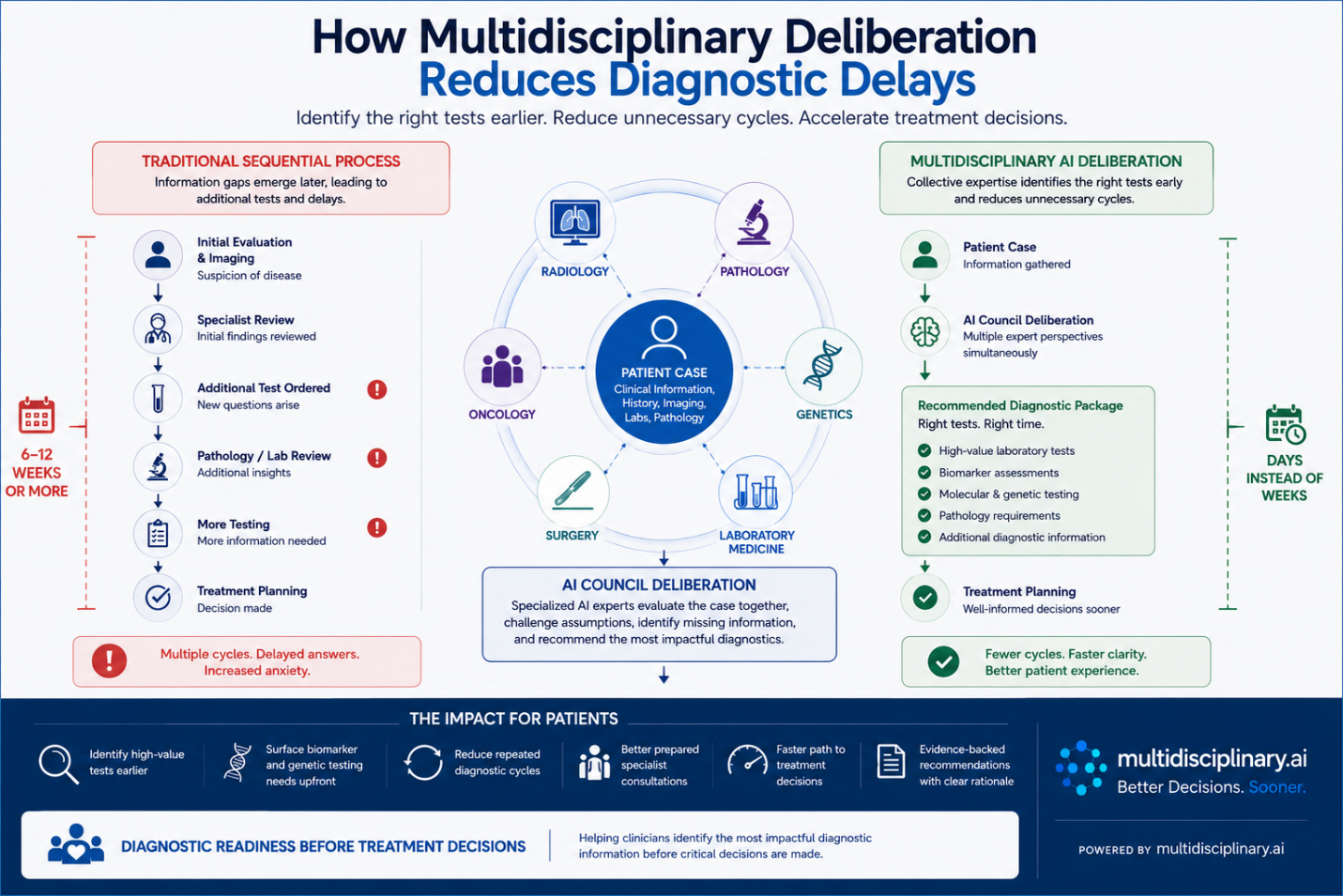
The challenge is not finding specialists — it's bringing the right expertise together early.
For patients facing a serious or complex diagnosis, time is often spent not on treatment, but on determining what information is needed before treatment can begin.
A patient may enter the healthcare system with symptoms, abnormal imaging, or concerning laboratory results. What follows is frequently a sequence of consultations, additional tests, referrals, and follow-up appointments as clinicians work to gather the information needed to make confident decisions.
While each step serves an important clinical purpose, the overall process can become fragmented, leading to unnecessary delays, repeated testing, and increased patient anxiety. The question many patients ask is simple: "Why couldn't we have known this sooner?"
The Reality of Diagnostic Delays
Consider a patient with a newly discovered lung mass:
- Initial imaging identifies a suspicious lesion.
- The patient is referred to a specialist.
- A biopsy is performed.
- Pathology identifies cancer.
- Later, an oncologist recommends molecular testing.
- Additional genetic markers are requested.
- Further imaging is ordered to clarify staging.
- Treatment discussions are postponed until all results become available.
Each recommendation is appropriate. However, many of these information needs are discovered sequentially rather than proactively. As a result, patients may experience:
- Multiple rounds of testing
- Weeks between appointments
- Delays in treatment planning
- Repeated consultations
- Uncertainty regarding next steps
For patients and families, the emotional impact can be significant. Waiting for answers often becomes as stressful as the diagnosis itself.
Why Information Gaps Create Delays
In complex diseases, clinical decisions rarely depend on a single test result. Treatment planning may require input from:
- Radiology
- Pathology
- Laboratory medicine
- Genetics and molecular diagnostics
- Surgical specialists
- Medical specialists
- Care coordination teams
Each discipline sees the patient through a different lens. When these perspectives are gathered one at a time, important questions may not emerge until later in the diagnostic journey. Examples include:
- Should molecular testing have been ordered earlier?
- Is additional pathology analysis needed?
- Are biomarker results required before treatment selection?
- Would further imaging change management decisions?
- Are there alternative diagnoses that should be explored?
When these questions arise late in the process, additional testing cycles often follow.
The Cost to Patients
Diagnostic delays affect more than scheduling. They affect the patient experience. Patients frequently report feeling:
- Uncertain. They know something is wrong but do not know what comes next.
- Frustrated. Each appointment generates new questions rather than clear answers.
- Overwhelmed. Information arrives from multiple specialists without a unified perspective.
- Anxious. Every additional week can feel like lost time.
For serious illnesses, the psychological burden of waiting can be profound. Patients often describe the diagnostic phase as one of the most stressful parts of their healthcare journey.
A Different Approach: Earlier Multidisciplinary Deliberation
Multidisciplinary deliberation seeks to identify critical information needs earlier by evaluating a case from multiple expert perspectives simultaneously. Rather than discovering information gaps one specialist at a time, expertise from multiple disciplines contributes to a broader understanding of the case at the outset.
This collaborative review can help identify:
- High-value diagnostic tests
- Biomarker requirements
- Genetic and molecular testing needs
- Additional pathology considerations
- Missing clinical information
- Potential treatment implications
The objective is not to generate faster answers by skipping steps. The objective is to determine which steps are most important before delays occur.
Better Prepared Before Treatment Decisions
One of the greatest opportunities in modern healthcare is improving diagnostic readiness. Diagnostic readiness means having the information necessary to support informed treatment decisions before critical conversations occur.
When clinicians enter treatment planning with a more complete picture of the patient, they are better positioned to:
- Discuss appropriate treatment options
- Explain risks and benefits
- Answer patient questions
- Reduce unnecessary testing cycles
- Coordinate care more effectively
Most importantly, patients gain greater clarity about their path forward.
The Future of Diagnostic Decision-Making
Healthcare continues to become more specialized, data-rich, and evidence-driven. As complexity increases, the ability to bring expertise together early becomes increasingly important.
The goal is not simply faster diagnoses. The goal is more informed diagnoses. By identifying the right tests earlier, reducing unnecessary diagnostic cycles, and aligning expertise around the patient, multidisciplinary deliberation helps create a more efficient and patient-centered path to treatment.
For patients facing uncertainty, every avoided delay matters. And every earlier answer has the potential to change the care journey that follows.